July 10 continued : Raraka

Hypothetical questions: If you had to flee your burning home and only had time to collect a few items, what would they be? If you were shipwrecked in the South Pacific, what would be five things you’d like to have with you?

Have you ever actually had to act upon the crunch of time and panic of emergency? It’s an interesting moment of clarity and confidence, since the choices made in that moment will carry through and define each moment that follows.

After we had made the decision to leave the rattling and frightening beached Kayak at sunrise and low tide, I prepared for the dawn escape. I threw my most valuable possessions in a waterproof stuff sack and a pelican case, a bon voyage gift from my lovely and wise friend Dana to protect what I had worked so hard for : my passport, wallet, telephone, computer and journals. “Brian, when we leave the boat, these must come with us,” I requested, as a back up plan.  It’s interesting how your brain works in an emergency: lucid yet crazy, forgetful yet clear.

Cushions from the benches in the galley had flown to the low side of the boat in the impact, so I fashioned a place to sit against the cupboards and stove, held in place by gravity due to the pitch of the boat, knees drawn in, comfortably and cradled. Although my body wasn’t moving, my mind was racing and alert, thinking thinking thinking of our options, of what daybreak would look like, of the past week ‘s crossing, of my family. I prioritized our safety, more for the sake of people who loved me, in order to curb any suffering they would feel if I didn’t make it back. I made a list in my mind of who to call when we could, and schemed a plan to make it back to familiar soil as soon as possible.

Brian followed my lead and sat close to me, although this time I didn’t mind because any comfort was welcoming in our predicament. We talked and lamented our situation and the events that led to it, regretted the immediate causes and dug deeper to the roots of this pickle. I recited lyrics to ALO’s BBQ, using the power that music holds over me to describe and assess a situation.

“The road is long and windy like a good mystery unfolding

It twists and turns in colorful subplots and sunburns and fake out endings

And sometimes my patience in the whole process starts bending

As I attempt to unravel the web by traversing and rehearsing and perversing along the doubt-laden extension chord thread of my life

And in this life we’re free to dream whatever we want to

But that doesn’t mean that your dreams are gonna come true

Instead as a way of getting us to move

Life dangles your dreams in front of you

And unable to resist the temptation, we continue

And it’s clear to me that this life is gonna be

All about the dangling possibilities that keep turning in and turning out

Yes it’s clear to me that this life is gonna be

All about the dangling possibilities

The road is long and windy

Full of twists and turns

But before you can rise from the ashes

You’ve got to burn baby burn

Welcome to your barbeque

Where we roast all the dreams

That never came true

Welcome to your barbeque

Pig out and dream a new

The crew of Kayak also forgave and felt as low as ever, felt faivre, felt crushed dreams…day dreams that we had lived and shaped for years prior to this conversation on the atoll.

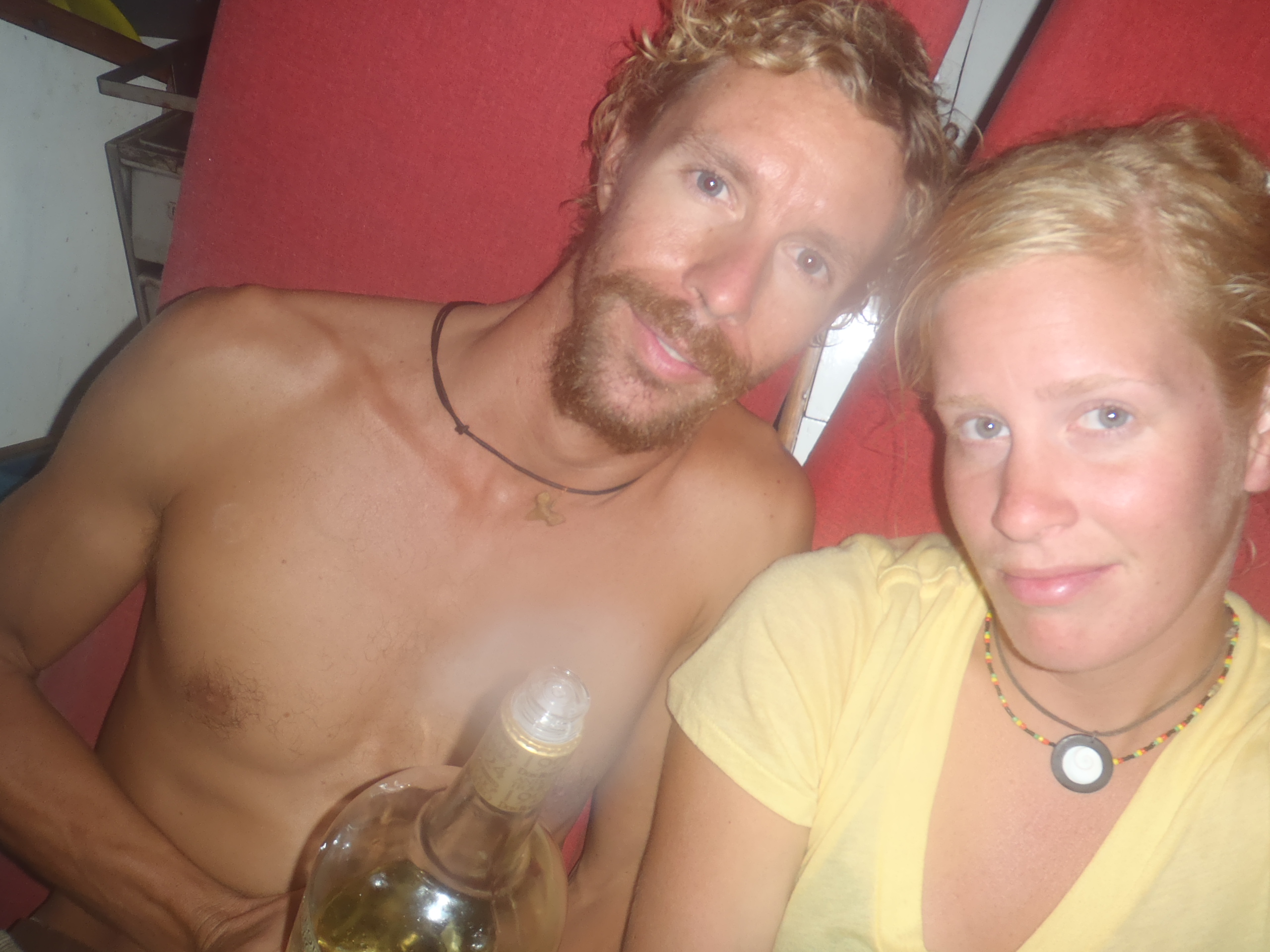
Still shaking like a wind-up toy, I pulled out medicine to calm my nerves : tequila. Alcohol became the medicament of choice over the next few days. Just a few swigs brought me back to equilibrium, in mind, not in boat. B indulged more than I, most likely because his state of mind, body, and consciousness needed it to even survive the amount of strain that he was experiencing.

B tried to sleep for 3-4 hours, until sunrise and low tide, our escape from the wreck and into the unknown, which seemed a better choice than inside a trecherous tin can.  Sleep was impossible for me, with the sound of the ocean, a relentless reminder, with the stress, unlike any other I had felt before. Experiencing its physical effects, cortisol and adrenaline stronger than any espresso drink, I continued to read, an autobiography of a life in stark contrast to my own. I finished Infidel by Ayaan Hirsi Aliin just 2 days of our crossing between the Marquises and the Tuamotos. Brought into the suffering, hope and solutions of many other women who suffer because of geography and religion, sharing their sentiment and learning of their plight, I attempted to ignore my own as I was contorted in the doorway to the hatch to remain in place and upright in a tilted, unnatural environment.

Once the book was complete, the immediate danger mitigated and my hormone levels returning to normal, I felt the need to lightly sleep. Daylight was a couple of hours away, so I laid on the galley cushions kitty-corner to where I had been knocked awake violently just a few hours previously.  My feet were against the armrest so that I didn’t slide down with gravity and I kept my knees locked and legs straight to remain sleeping at the angle of the bench. In my wearisome state, my knees would relax and I’d slip a few inches down with gravity. Awaking with a start, the waves again were a constant reminder of the predicament that I was in.

First light gratefully came at 5am. I pulled myself along and climbed the cabin uphill to take a look at our surroundings. Propping my ass comfortably at the edge of the hatch, usually 90 degrees but now an angle for a Kelly-cradle, my jaw gaped : Coral shelf extended for about half a kilometre wide, from the ‘large’ and open ocean to the lagoon. Low tide exposed the massive and gradual curve of the atoll’s edge, creating a perfect circle in both directions yet fading in the distance beyond eyesight. Large waves broke in curl and wash traveled along the atoll’s surface until its power was spent. Some small motus, or land masses, small islands, measuring only 1-200 metres long were about a kilometer away, perfect shipwreck sandy banks with characteristic palms and turquoise waters surrounding them. The lagoon to starboard side stretched as a calm lake surface further than my mind could conceive. The colours of sunrise were amazing, as ocean surface and open sky a pink to match the rock shelf that we were perched upon. Natural beauty contradicted our grave situation, and fear and uncertainty arose again. If we had been floating, sailing, sleeping, in Canada or on the moon, this beauty would still occur, still exist, despite any awake or present human eyes to view, grasp or appreciate. There is beauty in despair, beauty regardless of conception, beauty for the sake of the earth spinning, for scrutiny and for security.

Again I tried to radio PANPANPAN, explaining our predicament in English and in French, this time loud and with urgency, as opposed to the wavering and fearful voice from six hours ago. No answer. Not sure what we were expecting.

I began to pack again, this time with more time to think and process, for a trip to the village that was ”due north” of our current coordinate. We decided that paddling through the atoll was the most ideal next step, of taking initiative to deal with our naufrage. Pulling our PLB, personal location beacon, makes an emergency call to any nearby ships or radio receivers, without a message to shape the response. Since we were complete and sound of health and relative sanity, we decided against it, and to make our way to a place with a confirmed population. Brian had a friend who visited Raraka a few years ago, and this reference was the reason that we were heading towards the village and pass in the first place.

Unsure of the distance or the outcome after reaching the village, or if I would return to Kayak ever, I forced myself to choose the most important items for my backpack, besides, of course, the immediate and emergency response upon first impact. With my technique of Throw Shit in a Bag, I packed up half of my clothes, first aid supplies, toiletries for one…two…three…how many nights? I bundled up my French books, from studying in Quebec and the dictionary, lights, lighters, my jewelry, which all had life long sentimental meaning and gifts that I had received from my lovely friends on Ua Pou, Rudla and Kohu (flowering rock, carved bone pendant). Feeling the intensity of sunrise and knowing that our low tide  window would be short, I frantically packed a container with foody snacks : crackers, nuts, fruit, chocolate. I filled any bottle, canteen, urn or container that I could with water for the voyage. There was a lot of flotilla in the water as I pumped it from one of the two tanks, most likely due to the major slosh that they had received, churning up any sediment that had rest over the years since the tanks were flushed last.

Thinking along this pattern for the first time, we overlooked some essentials. We packed flares, but in haste forgot the more intense flare gun. Packing the GPS we left the epirb (PLB) and extra batteries. We forgot binocs. Rookie mistakes. I donned my compass like bling around my neck, purchased for the first week of Outdoor Recreation Management. I packed my small knife and B forget his newly acquired coconut slicing machete.

Now, what to wear for saving self from shipwreck? I didn’t bother changing my tshirt and shorts from my slumber while we were still afloat, but I learned during our crossing, due to the novels consumed, that shoes were important! I ensured that Brian and I were both wearing our sneakers for best sole protection on the atoll, a network of jagged rocks, urchins, coral and other nasties that would cut our perpetually bare sailing feet on first contact, rendering us useless and immobile. Thank you Thor Heyerdahl, for your tip and wreck from Kon Tiki! Maybe you proved nothing but the fact that it’s possible to sail a balsa wood raft across the pacific, that flying fish are edible and will make you delusional (https://greenintheblue.net/2011/06/07/day-25-flying-may-28/) and that your feet are important!

As I was assembling and collecting essentials for our journey, Brian was on deck attempting to launch the dingy by himself. Perhaps he was attempting to mend or fix our predicament by working alone, but a smashed apart dingy or captain swept under the boat in a strong wave would not be a beneficial occurrence to our already shitty situation. I came to help him drop the dingy on the rocky shelf, closer than any other surface we’d launched it on to. The row boat hung at a 45 degree angle from the mast, attached to the whisker pole halyard, over the reef and the wash, of less significance due to low tide. Before the boat was lowered and placed on land, and knowing the communication issues that B and I had in the past, I asked, and at the same time tied our survival to each other: “Please be clear with directions so we do this smoothly and safely. If something happens, I can’t do this without you.”

Just as the ocean rises and falls, so did my fear and uncertainty. Given a task or an idea to execute, I could focus and the emotions would fade away or become suppressed. In an idle moment, however, fear and uncertainty would arise again, coursing through my veins. Urgency grew as time ticked and tide turned, beginning to rise. There was a great gap of an unknown outcome to our next few steps. I began to rush, perhaps inflicting that sense upon Brian as well. I wanted to leave Kayak ASAP but I forced myself to breath deeply and take time to think clearly, which was hard with the waterfall of thoughts, ideas, what ifs, regrets, hopes, if onlys, song lyrics a melange in my head. (at this moment it was John Butler Trio’s Better Than…”Don’t let it get the better of the you…”)


I began to haphazardly haul our essentials for the “trip to town” from the V berth in the belly of the beast to the galley, then through the workshop, up the stairs to the cockpit and passed them overboard to Brian who had already jumped ship and was on the atoll. This was incredibly challenging as the boat was tilted over in such a way that walking was more like sliding or slithering along the downward side of the boat, and with two hands full of gear, each step was awkward and frustrating. When Brian had received each armload, he ferried them to the waiting dingy, about 20 feet from Kayak as to not be washed or tipped over by the small waves that continued to lap the edge of the atoll and smear themselves under the boat.


Once our essentials were off board, we closed the hatches yet left the main hatch open. At time of writing, I can’t remember the reasoning for this, besides perhaps if someone came along and needed something, or if we weren’t able to be around to explain the lock, the cabin would still be able to be accessible. By this time of the morning’s events, I still hadn’t stepped down on to my first atoll. Apprehensively and between unseen large waves that were cresting and breaking on the port side of Kayak, I jumped from the low side of the tilted wreck and hoped that a rising tide rogue wave wouldn’t wash me out without warning. The sea swirled around my ankles and my nerves calmed slightly, finally, once I was off of the steel thunder looking like an alien on the land.

 

Look at where we are. 


OLYMPUS DIGITAL CAMERA OLYMPUS DIGITAL CAMERA atoll sunriselook at where we are look at where we are look at where we are

Think about how many times I have fallen / Spirits are using me / larger voices callin’


Got out of town on a boat
Goin’ to Southern islands.
Sailing a reach
Before a followin’ sea.
She was makin’ for the trades
On the outside,
And the downhill run
To Papeete.
Off the wind on this heading
Lie the Marquesas.
We got eighty feet of the waterline.
Nicely making way.
In a noisy bar in Avalon
I tried to call you.
But on a midnight watch I realized
Why twice you ran away.
Chorus
Think about how many times
I have fallen
Spirits are using me
larger voices callin’.
What heaven brought you and me
Cannot be forgotten.
I have been around the world,
Lookin’ for that woman/girl,
Who knows love can endure.
And you know it will.
When you see the Southern Cross
For the first time
You understand now
Why you came this way
‘Cause the truth you might be runnin’ from
Is so small.
But it’s as big as the promise
The promise of a comin’ day.
So I’m sailing for tomorrow
My dreams are a dyin’.
And my love is an anchor tied to you
Tied with a silver chain.
I have my ship
And all her flags are a flyin’
She is all that I have left
And music is her name.
Chorus
Think about how many times
I have fallen
Spirits are using me
larger voices callin’.
What heaven brought you and me
Cannot be forgotten.
I have been around the world,
Lookin’ for that woma/girl,
Who knows love can endure.
And you know it will.
So we cheated and we lied
And we tested
And we never failed to fail
It was the easiest thing to do.
You will survive being bested.
Somebody fine
Will come along
Make me forget about loving you.
At the Southern Cross. 

July 10, 2011 : Raraka

Preface: I will be catching up on the entries previous to this, and I apologize that they will not be in order but I feel that the few entries to follow should be told:

After trying Katiu two times at both passes, we sailed from about 5pm to 1am for Raraka, to try a pass that Brian had heard was easy. Aiming for a slack tide at the pass, about 6am, in order to enter the belly button atoll center without current to sail or motor against, we first set up just the jib to carry us slowly through the night. Three knots an hour wasn’t sufficient to make the distance in the time that we had granted, so we raised the mainsail and carried along on a broad reach. After a delicious quinoa dinner, we sailed through the most dangerous archipelago in the monde at night, shared some music of each other’s that we had grown to like and had become anthems for our time on Kayak, and I began to doze well for the first time in days. As I was sleeping on the galley bench, like the good ol days when we were traversing the mer, with the V berth too bumpy to soak up the benefits of a bonne nuit, Brian tried to plot our course on the old charts he had picked up for a steal of a deal. He changed the course silently, not wanting to wake me as he understood that I was sleep deprived. Knowing the charts were quelque fois in error, as we learned on Nuku Hiva, and not checking his computer plotting program, something that he had all along but hadn’t yet used, I woke up to realize that the charts were wrong by one mile. And that Brian had fallen asleep too.

THUNDER echoed through the boat and my mind lurched awake as my body was thrown through the air and flew towards the galley, any pain unnoticed until the bruises were bumped against the next day.

“EFF” was the first and appropriately strongest word to exit my bouche in my fatigued slumbering stupor, ‘That was a HUGE wave,’ I thought, as everything that was loose from tables and shelves flew and fell to starboard side. Then a BOOOM, the worst sound and feeling I have ever experienced, as I repeated “EFF” with a shudder of fear. “Quoi the Eff,” as elbows and hips hit tables and counters. “Oh my Dio.” “Feeeeeck,” in Brian’s words. “What the hell was that?” then BOOOM again as the boat gigoter / agitated and tremorred, keeling one to one side, the steel hull reverberating against something more than just ocean. We’ve hit ground…the physical feeling was the lurch and angle and rocking sway as in Ua Pou’s experience …this time with a much stronger intensity and alarm because, as Brian had mentioned earlier in the same day, we are sailing in the most dangerous archepelego in the WORLD. The Tuamotos were close to unnavigable for cruisers before GPS became reliable and available.

As it’s been a year since I have written of this experience, let me refresh and set the stage:

It was midnight. We were sailing at about 5 knots per hours. We were both sleeping. It was a deserted part of the atoll. Kayak’s cabin was at a 45 degree angle and we could hear waves breaking around the boat and every four or five waves the crest of the water wall broke on the side of Kayak, its crescendo shaking the steel structure and pushing the sideways vessel and its two in habitants further onto its rocky resting place: a terrifying soundtrack.

The sudden and violent movement of the boat subsided quickly, and as the feeling of claustrophobia and uncertainty rose, I slipped along the slope of the wooden floor, the cabin now askew and littered with our belongings, pulling myself uphill. I had to use the table, door jams and shelves as handles to pull my battered body past the galley and up the stairs to exit through the cockpit hatch. I began to tremble as I never had before, almost emulating the shuddering boat as it was lifeless against the atoll. We began to survey what in the world, what in the ocean, had happened, and tried to figure out where we were.

The moon was brilliantly bright, half full and the clear skies carried unbiased blinks of stars, illuminating a sailor’s worst fear: shipwrecked. at night. in the middle of the south pacific. “Oh…my…goodness…” I said, my language less vulgar than at the initial shock of impact, each letter uttered utterly shaking as the tense breath escaped to only one person’s ears. “What….Do….We…Do?” The white wash of waves glowed in the moonlight, a blue hue of consistency and power, as we sat outside, crouched low on the high and exposed side of the boat. We could see the sets rolling in towards us, pushed by thousands of miles of wind power, and predicted which would rock the boat further. “Hold on,” one of us would caution, as the sea swell crashed to our bow or stern, and the seemingly harmless wave two back in the set would rock us, scrape the boat along rock and push us further on the coral shelf of pink rock, the colour visible in the soft and comforting moonlight. I was so scared.

Recalling being grounded on a sandy beach in a sheltered harbour in the light of day with new friends, other sailors and boaters around to lend a hand, I learned that an anchor rowed out and dropped, then pulled upon with the winch can help to free a stuck boat, but there was no way that could happen here. The waves, rocky shelf, dark night and being alone for miles ensured that that operation would be risky and futile. “Whatdowedo whatdowedo whatdowedo” was on my mind and on my lips to a captain who was just as or maybe more stressed. The adrenaline and emergency mind was kicking in, a survival mentality and a flight or fight response. Of course, these were only realized in retrospect, after tunnel vision has been removed and a solution realized.

The low side of the boat was intermittently revealing pocked pink rock as the force of the sea broke on the atoll and washed under our hull, from a white and wet wash. Crevasses from centuries of rock being beaten by the force of the windward side of the island were filled and emptied with each swell cycle, creating a frightening image of peril if one of us had been pulled by gravity towards the rock and wet place.

As I examined our situation and moved around the outside of the vessel, now lifeless and bereft of character, I was keenly aware of the beauty of our surroundings, as much as it contrasted with the steel slug wreck that we were confined to. Perfect little pacific islands with narrow sandy beaches and waving palms were a stone’s throw away, with a good arm, yet the rocky and threatening atoll washed with water was a great barrier to the idyllic refuge. The moon created a soft yin glow to the relentless force of the ocean to our port side and illuminated the interestingly pink atoll of solid, jagged rock to starboard. It gazed upon the island, the boat, the ocean, our situation and me with the same constant stare of console and indifference. The stars glittered away, too distant and revealing light from the past, sending a message of guidance long gone.

Nature is my spirituality, and the conflicting messages I was receiving from sky, earth and sea were both over- and underwhelming as life was potentially on the line. Mechanically, because of my roots and childhood raised in a Christian household, I surprisingly asked God to keep us safe. I have too much to live for! I thought of a little book with travel advice from above that my Nana had given to me before I left. She had given it to my father almost 40 years prior, as he traveled to Europe before he was married. I wanted to bring it back to her presence to complete the cycle once again. I also thought of my Aunty Glenda’s words, as she gave me a “crash course” conversation the same day that I saw my grandfather for the last time. “Never abandon ship,” unless it’s going down. The boat will float and is an anchor, so to speak. Although the shuddering and thundering didn’t feel safe, the walls of Kayak were a safer place than the turbulent cross-zone beneath.

“Be Careful be careful becareful,” I said to Brian many times as we worked against gravity to haul the mainsail and boom from it’s angle towards the low side of the boat to the middle, where he pulled tight the sheets and I, the preventer. We took down and tied the mainsail and the job while using stanchions, boat contours, cleats and lifelines as just that: handles and lifelines! “Please please pleaseplease do not fall off the boat,” I urgently and politely requested. The imagery of proceeding with our tasks alone was too much to ponder, and a rescue of either of us not another stress that we needed to add to our predicament.

We returned to the cabin after our survey and work, in shambles but safe from the waves, besides their continuous force, feeling and sound, to ask the question of the hour: Where are we?? Brian plotted our course and realized, again, that the charts err slightly. Still, one mile from shore would have been too close anyhow. He uttered regrets and ideas too large to comprehend or pay heed to at the moment. I tried to pull him back from the future and from the past to the present, to ask What Where How and Who…

I got on the VHF radio to make a pan call in English first, which was the simplicity that my brain needed at the moment, and in French next, noticing my voice shake yet speaking strongly to convey our situation and discover if anyone was nearby and listening. Distance and time of night prevented anyone from hearing us. We decided against using the personal location beacon, as we were not gravely injured nor in immediate peril. Our solution came down to waiting for dawn and low tide, happening simultaneously in five to six hours, to launch the dingy and paddle to the village for help. The village on Raraka was on the charts and had been visited before by a friend of Brian’s so its presence was certain, giving a glimmer of hope and future, yet the moments in between would be the sole responsibility of the crew on S/V Kayak: Me and Brian.

July 10 2012

One year ago I was shaken and shipwrecked, paddling a dinghy through a lagoon in french polynesia to an unknown fate…Two years ago we were celebrating life and love on land with Steph and Dave, sealing their fate…each of these experiences brought together some of the best people on the planet ♥

Il ya un an j’ai été secoué et les naufragés, en pagayant sur un dinghy dans un lagon en Polynésie française à un destin inconnu … Il ya deux ans, nous fêtions la vie et l’amour sur la terre avec Steph et Dave, sceller leur destin … chacun de ces expériences a réuni quelques-uns des meilleurs sur la planète ♥

The youngest Circumnavigator has fulfilled her dream!

Congrats to Laura Dekker!! Although we didn’t meet, she was keeping a low profile as she sailed out of Hiva Oa the day that we made landfall there. I love her plans for the future (not going to her homeland) and understand her thirst for a challenge, solitude and accomplishment. So inspiring!

Watch the pre and post sail here

“Dream is not what you see in your sleep…it is the thing which does not let you sleep” APJ Abdul Kalam

Banff Mountain Festival

The Wolf and the Medallion won the Banff Centre Award for Creative Excellence…and producer / director / artist / wise old man on the hill speaks to my own passions, silently with his paintbrush, addressing our disregard for our consumptive and ignorant use of plastics, to narratively with father to son correspondence, fostering curiosity and killing complacency…

Message in The Bottles from Jeremy Collins on Vimeo.

Closure to the Infinite

The last time I saw my grandfather in person was tumultuous, emotional and had my soul and spirit pulled in different directions. North South East and West, Up and Down. Perhaps appropriate for the journey I was about to take. Upon return, after his soul and body were separated, the dust and drops of my adventure had settled, I attended his last moments above land, aided his peaceful passage back into the earth.

My heart had decided that spontaneously sailing the south Pacific sea was sane and sound, and my friends and aquaintances backed me up. My head was reeling in a conversation with my family en route to the hospice to see my grandfather for a final time, instilling doubt and shaking the decision that I had made in confidence. They were, of course, showing me their concern and unyielding love, which I found touching and trying. I didn’t have reasonable responses to their deep inquiries and the dream fulfillment that faced me seemed flighty and not well thought out. Before being with my family this day, I was solid and steadfast in the chance to follow my destiny. I was already teary eyed and sniffling before we entered the comfortable house of segway between two worlds.

The spring sun was warm and after navigating through corridors and elevators, with codes and secret handshakes as barriers to deter patients with dementia from escape, we found my grandfather wrapped and warm sitting in the courtyard. I got a hold of myself with some deep breaths and a splash of cold water and went to enjoy the moment with the family. His blue eyes, passed to my mother and sequentially to me, were like the sea I would soon sail, his white cozy blankets cumulous clouds that would pass over the vessel I would inhabit for the months to follow. He was his sassy self, smiling and at ease. Pain free yet missing his own home, he was content and we spoke of everything but the reason that he was in the kind hospice. When the sun descended we fought with the coded doors to reenter, wheeled Grandpa to his room and made some coffee. My Auntie G, in her Topsiders, saddled up to me for a frank and informative conversation. Although most of my kin was against the thought of little curly Kelly setting sail with a stranger, if I was to do this anyways I should know some tips from a sailor herself. Auntie G taught me: always stay with the boat, no matter what…they float; If a hurricane tosses the vessel around, tie myself down so I don’t get tossed around; Always wear my harness, clipped in, when on deck at night; Check into gadgets and gizmos aplenty for communication and safety. She inquired: Do we have a life raft, epirb, SSB, submersion suits?; What is his certifications? She assured: I am strong and smart and am following my heart. Thanks Auntie G!

As my mother reminded me of the reason for the visit, we made our way to my G.pa’s room. Just outside I faced his wife, a grandmother to me for 20 years. I told her of my plans and she embraced me as if she wouldn’t let me go. “You can’t leave us. You can’t leave your family when your grandfather is going to pass away.” Immediate heartbreak. Crushing guilt wrapped around my neck. Conscious and deliberate contradictions to my plan. The scales were weighted heavier again.

I composed myself once again, and tried to not let this weight affect any time with G.pa. Chatting with him, holding his hand, and explaining my plans to him were the easiest parts of the visit. He was happy for me, and at peace with the fulfilling journey we were both going to take over the next few months. This helped to settle to my heart and my nerves.

After being at sea for 29 days, without contact from the outside world, save for a quick radio call to a passing freighter, I finally reached land and was able to reach out to the connections that I had defied and denied back in Canada. Through various correspondence between family members regarding details of planning my Grandfather’s funeral, I learned that he had passed away on May 21. Two days before we arrived to solid ground the funeral was held. I looked back at my ship’s log and thought the lyrics within the entry quite appropriate for a sad day in the hearts of my family. My father emailed me the news, slightly more personalized: “If you look up at the stars tonight and look waaaaaaaaaaay past them you will see the hazy edge of heaven where your Grandpa is dancing with Grandma right now. …………… Can Mennonites dance ?!?!” The metaphor is satisfying, as moving to soul music and connections with the universal sparkle are highly valued experiences to me. I spoke with my parents a few times online, and attempted to give verbal and virtual hugs to them, especially my mother, who had lost her father.

Now back on dry land and settling into a vagabond’s life in Canada, more of the family was available to finish the business of burial. There were details to decide upon, regulations with remains to adhere to and arranging a small collective to be available took some time. The week beforehand I went out for dinner with my step.grandmother, and she asked if my trip, the joys and pains, the sailing and the shipwreck, were worth leaving my family for. I explained that it would have been hard to turn down a chance to live my dreams in the chance that there would be a funeral to attend. She assured me there certainly was going to be a funeral while I was away. I don’t regret my decision, I learned an ocean about myself, and I’d do it again, with some alterations, I explained. It broke my heart to be out of contact with people I know would worry and wonder about my well-being. The isolation was not easy. I hope that I explained this to a widow well enough. She’ll have to take me for how she perceives me. We still share respect for each other.

Driving to the maze of Surrey on September 24, almost four months after G.pa had joined my true G.ma, the grey skies threatened rain and tornados of leaves spun around our ankles. Walking over headstones and buried caskets conjured images of how the lives below had lived, each differently than anyone else on earth, with their own challenges, connections and contentment. G.pa was to be buried in the same plot as his first wife, and it has been years since I’ve visited her there.

The gathering was small, but connected because of my G.pa. What struck me the deepest, nearest and dearest, were accounts of G.pa’s strong silent type, unless he was telling a story or making a sassy joke, and how he expressed his love and care to people through hard work and action. He was a busy man, always with a project, and always directing his expertise and energy toward someone to display his affection and ability to help. These are qualities that I have harboured and honoured within myself. The family ties are strong in this realm. I am blessed to have inherited those qualities to continue.

I read to G.pa and the collective present from my ship’s log. The day he passed away I had deciphered lyrics to ‘Sad and Lonely’. The music that moves me runs through my veins. The day after he had passed, we sailed through squall after squall and the horizon was littered in rainbows, an atmospheric pleasure for me, and considered a promise in the story of Noah’s Ark, taught to me at a young age. I found it outstandingly heartwarming in retrospect that Grandpa was with me out at sea and had, unbeknownst to me at the time, expressed himself through avenues that I value and cherish: His story was sung through an emotional song one day and the next brought bright and fleeting rainbows, an optimistic act of nature.

I pulled an orange rose from his flower arrangement to leave in the rainwater of my Grandma’s vase, a perfect fit and the same shades as sunset over sea. Feeling ‘I miss you’ and saying goodbye, I turned to catch up with the crew, passing the neighbouring headstone, whose last name read ‘Hinton’. A sign of things to come…

Day 18: KuKuKaChoo : May 21

Day 19: less than 1000nm : May 22

…Something different is in this equatorial air. Clouds hamper horizon views but they are not static. A variety of vapor shapes drop sheets of rain and we can see the course of these storms, or squalls in sailing terms, if they wreck havoc upon us.

A spattering of rain dusted the deck, a welcome wash of fresh water. Rain in sunny climates of course translates to rainbows, arc-en-ceil. Completing its reach, a full arching glowing message of change.

This slideshow requires JavaScript.

eternal éphémère

oh la laa…

I suppose it seems as if I’ve dropped off the planet…well technically, yes, I did, a few times over. It’s interesting, though, with the planet a sphere and all, how one finds themselves right-side up wherever one tends to land. Cat like, I suppose.

Packing up my life and leaving town, friends, family, under encouragement and envy, worry and well wishes, jumping over to Mexico and then into the big blue, within weeks, was once this year. Then savouring the simple pleasures, moments with people and places, enhancing my internal workings and integrating the outside world, I focussed on the present and not on pecking away to share the moments with the cyber eyes. Second time I fell from earth. I very well could have disappeared into the jungles and cliffs, fruit trees and friends of Ua Pou, but that will be next time. Third time was charming, as my dream of sailing to atolls was fulfilled in the most unexpected way. I will elaborate soon.

Now, back in the comfortable and wild homeland of Canada, I have been trying to find my place and thrive, trying to make the world a beautiful place, and I’m about to slip off the face of the globe a fourth time in a few short months. My plan is to move to Alberta after Thanksgiving weekend, as if I’ve had enough of the ocean. This isn’t at all the case, but I’m looking forward to friendship opportunities and a chance to roll all of my experiences into one kick ass position, professionally and personally.

I will be slowly transferring my journal to text, memories to memoirs, and share some of the details regarding the intensity of living in the moment, for better or for worse, and all that has transpired over the past few months. It’s juicy, I promise…

If I could sum up the entire sentiment it would be cliche: Be careful what you wish for!…

This slideshow requires JavaScript.

Enchanté, Ua Pou

We left Tahu Ata at 8pm, after a nap and dinner following our long day out foraging. With strong winds and big seas, we expected to take twelve hours for the 70 nautical miles to Ua Pou. Plotting and setting our course for the west side of this new island, we chilled in the cockpit until about 10pm when we decided on shifts for the eve, 2-3 hours watches each. I slept first, lightly, because of the heat inside the cabin and due to the bumpy seas.

After skirting the edge of sleep I got up at 1am to relieve Brian, but first we changed our course to wing and wing. The wind vane was meandering 25 degrees to either side of our destination at about 4am so we had to pay particular attention, but the star shine in the middle of the isles in the middle of the Pacific was amazing and luminous, reassuring and prehistoric. Their consistency and strength allowed for strong Polynesian paddlers to navigate with ease between archipelagos, explorers of the Pacific who found and founded uninhabited rocks surrounded by miles and miles at sea.

I woke for the second watch in the night, this time with first light to see the island that we were soon to fall for. The landscape was majestic, rugged and rocky. Volcanic plugs stood strong all over the island, clustered inland and together, islands unto themselves, or small burps of basalt that lingered above otherwise sloping island sides. The consistently strong winds made for large waves to ride, and the sunrise illuminated the breakwater at the top of each swell with a green enlightenment, perhaps a hint to the green flash that is said to occur when the setting sun illuminates the top layer of ocean.

A welcome moto gave us thumbs up, the shelf a base for a towering monument at the southern tip of Ua Pou. This rock is known as Tuakahu, and contains significance for the first inhabitants of these islands, perhaps inspiring stone carvings of their tiki gods, as well as the missionaries who traveled far and wide to share their establishment with these peaceful people, introducing Cathedral for an alternate name.

Because the land mass interrupts regular flow, and we were traveling to the leeward side of the isle, the winds ceased and we tacked back and forth in order to make our destination. Vaieo Bay, also known without encouragement as Plan B, was a large, isolated cove with deep anchorages, not a building in sight. The only signs of life were two fishermen who were paddling their vaka, or outrigger canoes, to pull up fish for their families. As we had read in a glossy newly published magazine guide, the Yachtmen’s Guide to French Polynesia (the women know better than to read this false propoganda), the Valley of the Kings was a must see, and near this bay. However, landing spots on shore for the dingy looked bleak, there didn’t seem to be a road or trail to carry us inland to this fabled destination and the only other sailboat we saw carried south past the bay on their way to Haka Maii, the next bay south, where the guide suggested that we begin time on land for the Valley of the Kings. Deciding that we’d have more luck on land from the same small village, Brian hauled up fathoms of anchor chain (the windlass, a type of winch for the anchor, has been stuck and snagged, so the Captain gets a great workout each time we need to pick the hook).

We turned back south after asking the pechers (fishers) about the quality of the anchorage there. Because it was their village, they guaranteed it. When we were held fast close to the boat that had passed us and in front of Haka Maii, a village like many in the Marquises, at the mouth of valley, lush and hilly, with a multipurpose community area and church at the leading edge of the rocky beach, we took a nap. We were exhausted after little sleep during the overnight passage, intense sun in the morning, strong gusts and much maneuvering, and Brian’s chain gang workout.
The afternoon tick tocked away, and when we realized that in a few hours it would be dusk, we decided to hit the land and see where we would be lead. As we launched the dingy from Kayak’s bow and began to row towards the boat ramps, 5 or 6 young men began to gather at the water’s edge, as one of their friends had swam out to the 5 person vaka that was moored between our boat and shore. This brave soul was the sole soul in this outrigger, and we realized that he intended to paddle the yellow banana boat to shore. As the strong winds massaged the water’s surface for many kilometres, the swell was large and waves crashed against the rocky beach, meeting the base of the boat ramp and ejected spray a few metres into the sky with the most powerful waves. The fearless Polynesian began to slowly creep up towards shore, glancing to his stern continuously to check the pattern of the swell, which rolls in sets, as every ocean dweller knows. Everything about him was strong, from his jawline that was stressed for concentration, his dark eyes set in determination, to his biceps seasoned to paddling, his dark Marquisian tatu down one arm, summoning tradition and history, to his paddle strokes, quick and efficient to move the boat in his desired direction. The men onshore were shouting direction and encouragement in their deep Marquisian language, asking him to paddle or wait, to go now or no, the wave is too big. They came closer down the beach and the concrete boat ramp, waves crashing on their feet and larger ones up to their waists, when eventually they were swimming and being tossed around in the white froth in order to get closer to the vaka to aid in gliding it safely ashore. Finally the pilot of the banana boat was satisfied with the calm moment and he paddled with the might of his strength and endurance to shore, where the others were ready to catch the long boat alongside outrigger and hull. The rower lifted his body with ease from the cockpit as the boat reached the hands of his waiting friends and they gracefully eased it out of the water, up the ramp and onto stretchers. Their ancestors would have been proud of their voracious patience, protecting assets and heritage, skill and agility.

Needless to say, we decided that the waves were too big for our little hard dingy and the locals who had helped with the yellow vaka were meandering away. I didn’t feel that we could elegantly, or safely for that matter, follow that performance. Instead we tootled around the little bay, avoiding turd-like clusters of lava rock plopped alongside and one in the middle of the slightly sheltered hold. We saw a couple people from the other boat snorkeling, lighting the idea that we could swim to shore in the morning. We spoke with the family from Theitus, a mix of older Europeans and younger Americans, about life on a sailboat in the Marquises, and paddled back to Kayak for vodka with freshly squeezed OJ and chess.

Then began the great breadfruit experiment!

This slideshow requires JavaScript.

Foraging Fruits in the Forests of Tahu Ata : June 6-9

After getting in touch with plants and plains again after some days on the south side of Hiva Oa, climbing the highest roads we could find, replenishing our deprived souls with all the fruit we could find, sharing with other yachties and with my friends and family through various technologies, refreshing my French skills and picking a few Marquesian words, it was time for our first inter-island sail. We left the busy bay of Taa Huku about 3pm with sunny skies, a welcome difference from the grisly downpour with which we entered this port.

The passage was a short one, with Tahu Ata visible as soon as we left the mouth that had swallowed us back into civilization. We had smooth sailing and golden hills to welcome us as the sun set west, directly between Hiva Oa and Tahu Ata. Brian plucked at his guitar while I savoured the new views of this land that we were about to explore.
Three little coves on the north side of Tahu Ata each had their own sandy beach lined with palm trees, a few buildings visible beyond those coconut fences and not a soul in sight. The first bay came recommended in one of our guidebooks, but was occupied with one sailing vessel. Leaving the privacy of the beach to the lucky early birds who had arrived there before us, we aimed for the middle beach, Ivaiva Iti, while the small western one seemed more exposed. As we neared our destination, the wind calmed and we had to motor in as to have an accurate and accident free anchorage. Just as the golden hues turned their pink and fuscia, we plunked down the pick and were the only souls in sight.

Waking the next morning with a beach to be explored, yet this new rock untouched by our salty feet, we took our time to absorb the beach’s vibe, to build anticipation and to drink our coffee, of course. We could see a few empty habitations, hammocks, palm trees and patches of grass just beyond. Either side of the bay was lava rock lined with sloping mounds barriers to the bays on either side of us. We loaded our bags with swim, snorkel and lunch gear, and paddled in the dingy to a surfy landing.

Discovering the features of this bay, we swam in the blue sea and skimmed either side of the bay’s black boundary that had been produced with the raw material for beginnings of earth, old lava that had been spewed years previously and its slow deconstruction back into the ocean by the relentless power of the elements. Shallow pools trapped crabs, amphibious creatures and fish, while the powerful waves occasionally burst through a small blow hole in a shower of sea foam. Scouring further from the sea, we found square net hammocks, one full sized and one weekend fishing sized homes, shelters for canoes (vakas), fire pits and plenty of fruit trees. Brian climbed palms for young coconuts despite an adversity to their taste, and pick cheek-puckering oranges. After a power boat dropped off a man and we made small talk about his weekend getaway home and asked permission to have a fire in front of his property, he invited me to pick from the pamplemousse tree before he let out his ten piglets and their mama and left again. I loaded up on limes and pamplemousse, plucked shells from their sandy shelter and hauled fallen palm fronds to a pile to light ablaze later in the evening.

Top Secret, a catamaran full of new friends that we had met on Hiva Oa cruised into this private bay. When they came to shore we drank and discussed the cruising life, and our pre and post trip lives. Brian and Kendra made a run to the boats for food, musical instruments and blankets to spend the night on shore, while David, Rob, Annie and I prepped a fire and radioed to the taxi team for the things that we’d forgotten to order. As sun set and fire smoldered, we played ukuleles, guitars, drank beers and margaritas with Ivaiva Iti plucked limes, ate sandwiches and cuddled with the two friendly kittens who roamed these sands. When the firewood was crisp and the cups dry, Rob and Annie headed back to Top Secret while four of us slept in the sandy hammocks, my first night sleeping on land in almost 2 months.

In the morning, we knew that Captain Rob was eager to go, so we woke and David helped tidy the front yard that we had sullied in our relaxation. Brian paddled him and Kendra back to Top Secret and eventually made his way back to the beach with coffee! Great delivery service! In the meantime, I sawed away at coconuts, eager for their revitalizing water after sour tequila drinks the eve before. Taking way too long for the reward at the end, but thankful to finally get into a couple of cocos, I ended up spilled half of the water chasing a run away plastic bag that the wind tried to deliver to the ocean. A refreshing swim alone on this beach was paradise found and I thought that I could make a life quite easily for myself here. Then the owner of the other little house here showed up, as if to say that squatters would be found out! He was with his nephew and they beached their outrigger canoe, aided by the motor on the back. I offered to help them haul the boat out of the surf zone, and learned that this weekend home provided limes, coconuts and grapefruits to sell to Aranui, the large ship that visits the Marquesas twice a month from Tahiti, bringing supplies, buying fruit and in the meantime dropping budget tourists off to stroll around villages and up to ruins.
Knowing that many more places of interest awaited us, we left this beauty beach for the southwest side of the island, feeling blasé from the booze. We were aiming for Hapatoni, an artsy village center and supposedly calm harbour. During this sail we experienced the common Marquesian gusts that rip their way down the steep mountains to the sea. The winds were quite variable, from a dead calm to strong along the land, from one direction to another in a matter of moments. We tacked back and forth to make use of the wind that blew our way as we hugged the coast of Tahu Ata.

Cruising into Hapatoni with the winds bowling down the hillsides, the anchorage was empty, seemed to be exposed and without an obvious dingy landing. We circled this bay a few times, rocked by the wind continuously, unsure of the reassurances given in a yachter’s guide and the deep water of the seemingly safe middle of the bay. Brian was listening to his sea gut and didn’t have a great feeling about the place, so we turned back north against the wind and made for Vaitahu. Anchoring among a few other sailing vessels, we guessed at the best dingy landing being the concrete boat ramp and we went to shore for the hour before sunset.

Usually the magasin / epicere is a good place to start a journey in a new town. They have cold consumables for sale, we can ask locals for directions which usually ends up in a delightful or strange conversation, and we can check out what supplies we’d need for Kayak. In Vaitahu, I bought a creamsicle and Brian a juice box, we ordered some loaves of bread to be made for us in the morning and we began our saunter through this friendly town, situated at the flattest spot of the valley and surrounded by vertical sloping craggy cliffs. Passing people our age on the field in front of the church playing handball, we met some locals who offered conversation, local knowledge and pakalolo. I turned the latter but still made friends with Te’ii, with warm eyes, dark wavy hair, keen to talk, a traditional Marquesian sleeve tatu and a very friendly Capricorn. He offered to walk with us in the morning to the forest and pick fruit. Without other plans for the day, we accepted, while avoiding the persistence of another local known as the Professor, who was offering car rides, midnight fishing and Marquesian language lessons, a little too eagerly. Heading back to Kayak before dark was our excuse out of an awkward situation, but we didn’t avoid an uncomfortable dingy launch. From a slippery boat ramp into a swell is not ideal, but a lovely gentleman helped push us through it and we sang thanks and praise as he pulled himself from the waist-deep water.

The next morning Aranui was docked at the pier and dwarfed the town with its metallic mass. Trucks were lined up to trade wares, the place crawling with people for the exchange. Te’ii was helping with this and we were going to meet him once he was done his part. We attempted another landing place, with success, and met our friend, guide, fruit whisperer for the day. Beginning our walk uphill towards the palm plantations, we stopped at his house, met his friendly sister Rachelle as he opened a few young coconuts for Brian and I. We turned for the forest and Te’ii walked next to each other barefoot, while Brian spoke with a couple other young men who were making the same trek. I picked Te’ii’s brain about everything, from life on the island to with his family, and his personality, enthusiasm to be with strangers, social yet secretive, helpful and hard working, reminded me a lot of myself. Then I learned that he was also a mountain goat, with a love and knowledge of the forest, and we shared the same celestial sign. We walked up the dirt road and through the coconut plantation, past tikis and stone ruins of a civilization long gone, learning of the copra trade, the lack of land ownership and how people on this small isle make a comfortable living. The whole day we had Te’ii’s dog follow us, a white puppy without a name, so we called him Chein.

After the hacked coconuts, we picked grapefruit, climbed breadfruit trees, selected guava, reached for and basketed mangoes, chopped bananas and clambered for oranges. After hiking for a few hours in the forest, we went towards the water and chose pomme citel, cut chilis, collected nuts, questioned the spiky fruit, plucked pumpkin greens and harvested a pacific pumpkin. I tried to translate Bob Marley’s Guava Jelly into French to explain my love for the confection.

Speaking French the whole time was a challenge to my limited knowledge but also enlightening because we didn’t deviate from the language, unless Brian and I were speaking together, and although I didn’t understand one hundred percent of what Te’ii was sharing, I got 90% of the jist and was able to use the language to question words of ideas that he was sharing with us. Te’ii didn’t seem to mind my limited tongue, being patient and understanding. Perhaps much of my fatigue after collecting fruit and ideas was not only due to physical exertion but mental as well, intently listening and ensuring that my outgoing words would fall on comprehensive ears.

After the cache was a large as we could carry, we had a frosty Hinano outside of the magasin and I inquired about the church, a mainstay and forefront in many villages, learning that everyone went to church and respected the ideals of the institution, but of course still lived freely and without guilt. After the Hinanos, Brian, Te’ii, Chien and I piled into the dingy with our collection for a beverage on Kayak. We made margaritas and pulled out the charts so that Te’ii could point out some choice places on Nuku Hiva to visit. He asked what we’d like to exchange with him for his time and for the amazing stash that we had collected. He suggested our ipods, sunglasses, alcohol, tobacco, music. I suppose most of these are hard to come by on these islands, or expensive. A pack of cigarettes is about 800 Francais Pacifique, equal to $10 CDN. We gave Te’ii the dregs of the tequila bottle and the few CDs that I had to trade, knowing that he like reggae music, and Brian contemplated his shades as well, but with the paddle back to the shore with the waves, the transfer of Te’ii and Chien turned tumultuous and they forgot to swap their sunglasses.

This slideshow requires JavaScript.

Previous Older Entries